Showing posts with label Health. Show all posts

Monday, 12 August 2013

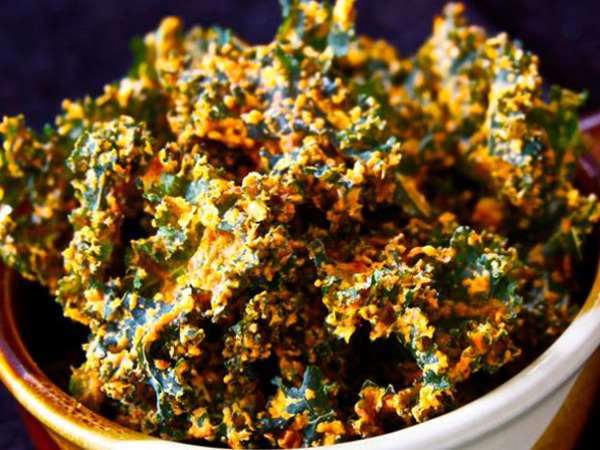
Healthy Chips: Healthy Kale Chips

Do you love chips, but avoid them because they are high in calories? Not anymore, because Padmaja Vasireddy – Food and Nutrition Expert, California,  has shared with us  a healthy kale chips recipe. These chips are not only yummy, but are packed with nutrients.

Ingredients: 
  • 2 Heads of Kale leaves, thoroughly washed and Dried
  • 2 Tbsp Coconut Oil/Sesame Oil/Olive Oil
  • Salt to Sprinkle
  • 1 Tsp Hot Paprika or crushed pepper flakes (Optional)
  • 1 Tsp Sesame Seeds (Optional)

 Method
  1. Preheat the oven to 350 degrees F. 
  2. Remove the ribs from the kale and cut into bite size pieces. 
  3. Toss the leaves with the choice of your oil, salt, paprika or crushed pepper flakes, sesame seeds and place on a baking sheet. 
  4. Bake for 12- 15min until crisp.
  5. Squeeze some lemon juice for a tangy taste. 
  6. Enjoy crispy, healthy Kale Chips.

Healthy Drink: Minty Mango Drink

Minty Mango drink, an innovative variant of the traditional kairi ka panha, is a refreshing drink, which is perfect to beat the heat after a long tiring day. Besides, it is also a great source of vitamin V (considered to be the member of family of B complex vitamins especially the niacin since it contains nicotinamide) which helps in preventing sunstroke and boosting immunity. Try this recipe shared with us by Shreya Brahme, Dietician and Nutritionist and blogger at Dietician Shreya.


Ingredients: 
  • Raw mangoes - 2
  • Mint leaves -1 cup
  • Jaggery -2 katori
  • Roasted cumin seed powder -1 tsp
  • Cardamom powder -1tsp
  • Salt to taste
  • Water

 Method:
  1. Boil the peeled raw whole mangoes and jaggery in 1 and 1/2 cups water, until they are soft and tender.
  2. Drain the excess water. Allow the mango mixture to cool down. Add freshly washed mint leaves along with the other ingredients and blend, until it becomes a pulp.
  3. Store this pulp in the refrigerator.
  4. You can make this in advance and store it.
  5. When you are ready to serve it, Mix a large dollop of the pulp in a glass of cold water and serve. 

Note:- You can add the jaggery, water and salt levels according to your taste.

Wednesday, 7 August 2013

Raw garlic can halve lung cancer risk

Eating raw garlic twice a week can nearly halve the risk of developing lung cancer, even lowering the danger for smokers, a new study has claimed.

Chinese researchers found that those who consumed raw garlic as part of their diet were 44 per cent less likely to suffer the disease.

Even when they allowed for whether people smoked – the biggest single cause of lung cancer the scientists found garlic still seemed to reduce the dangers by around 30 per cent, the 'Telegraph' reported.

Previous research has suggested that the popular herb can ward off stomach cancer and colon cancer, and a study at the University of South Australia suggested that it could reduce the risk of bowel tumours by nearly a third.

Scientists at Jiangsu Provincial Centre for Disease Control and Prevention compared 1,424 lung cancer patients with 4,500 healthy adults.

They found that those who ate raw garlic at least twice a week were significantly less likely to get lung cancer, even if they smoked or were exposed to high-temperature cooking oil fumes, which is thought to be another trigger for the disease.

The key ingredient behind this effect seems to be a chemical called allicin, released when the clove is crushed or chopped, according to previous studies.

It is thought to dampen down inflammation in the body and act as an anti-oxidant, reducing damage from so-called free radicals to the body's cells.

However, it is not clear whether cooked garlic would have the same effect.

"Garlic may potentially serve as a preventive agent for lung cancer," researchers said.

The study was published in the journal Cancer Prevention Research.

Monday, 5 August 2013

Tips for better health care

  • For building iron in your body eat plenty of spinach juice.
  • If you exercise with music, you will exercise longer and enjoy it more. Choose something upbeat and energizing.
  • On a busy day, take 20 minutes to go for a brisk walk to help reduce stress.
  • Eat most of your fat and calories for the day, in the morning. Doing this will put your metabolism into high gear. Then eat lean the rest of the day.
  • While running, if you have stomach cramps, stop and bend forward from the waist. Breath in and out, slowly and deeply while contracting your abdominal muscles.
  • While doing housework, increase the pace to get some extra exercise and calorie burning.
  • If you are having problems with migrain headaches, drink some hot tea with honey and this should help ease the pain.
  • Always take the steps instead of the elevator if you plan on cutting down those extra calories.
  • Eat a bowl of oatmeal each day to lower your cholesterol.
  • Drink plenty of water since it helps liver function well and your body will benefit and that will show from your glowing skin. So also drink plenty of water before, during and after exercising.
  • To lower blood pressure, improve your mood and relieve depression, exercise regularly.
  • If you experience pain, dizziness, shortness of breath, irregular heartbeat or increased fatigue while exercising, call a doctor immediately.
  • Begin your workout with warm-up exercises and end with cool-down exercises.
  • If you suffer from eczema, avoid heat and sweating.
  • Wear loose, lightweight clothing while exercising. Choose natural fabrics that will breathe.
  • When it is hot outside, drink more water and avoid caffeine and alcoholic beverages.
  • Ear ache - place a piece of potato (raw) in the ear-remove later.
  • Breathe naturally while doing stretching exercises. Never hold your breath.
  • Make soups the day before and refrigerate. Skim the fat off the top before reheating.
  • To feel as though you are eating more, slow down and chew thoroughly. Take at least 20 minutes to eat a meal. Taking longer to eat will make you feel fuller and also helps in digesting food properly.
  • When going to see a doctor, write down the questions you want to ask. Also, write down the answers. If you don't understand the answer, ask again! Take along any medication bottles you are taking.
  • Keep your attitude positive and smile.
  • urning down the lights an hour or two before bedtime will help you get a better night's sleep.
  • Avoid smoke-filled rooms and breathing or exercising near busy roads. Exercise in clean environment.

Exercise may boost mood in pregnant women

Tired, moody and pregnant? Get some exercise!

Exercise may improve the mood of pregnant women and help reduce their levels of fatigue, a new study has found.

The study, by Anca Gaston and Harry Prapavessis at the University of Western Ontario, examined whether a four week exercise intervention programme would result in improvements in the psychological well-being of previously inactive pregnant women.

The results were clear, with participants reporting significant improvements in their mood during the programme.
They also saw reduced levels of fatigue, suggesting that pregnant women should be encouraged to engage in regular exercise to improve both psychological and physical well-being.

While postpartum mood disorders like postnatal depression are widely recognised, rates of depression, anxiety and fatigue are actually higher during pregnancy than following pregnancy.

Possible complications resulting from depression during pregnancy include insufficient weight gain, increased substance use, premature birth, small babies and reduced intention to breastfeed.

The authors highlighted that children of mothers who are depressed or anxious during pregnancy have higher cortisol levels at birth and adolescence, impaired cognition skills and greater risk of developmental and mental disorders.

Moreover, fatigue during pregnancy has been associated with increased risk of caesarean delivery, disturbed sleep, and a negative impact on physical and mental health.

Sunday, 4 August 2013

Nutritious banana candy likely to make way in Gujarat mid-day meal

A nutritious candy rich in vitamins and iron made out of banana stem could be a part of the mid-day meal scheme for Gujarat school children grappling with the problem of malnutrition.

Recently, a Gujarat government official has shown interest in introducing the candy in mid-day meal scheme of the state schools, Navsari Agriculture University (NAU) scientist B L Kolambe told PTI.

"Costing less than a rupee, the candy made out of banana plant has medicinal value. It is made out of central core (stem) of the plant's pseudostem," Kolambe said.

"The candy is rich in fibre, iron and vitamin B, and suitable to meet the nutritive requirements in anaemic (having less than normal quantity of hemoglobin in blood) children," Kolambe said.

"During tests conducted at Central Food Technological Research Institute (CFTRI), Mysore, the candy was found safe for human consumption, and all the fibre in it was revealed to be digestable fibre," he claimed.

When contacted, Gujarat government spokesperson Saurabh Patel said that it is a positive development to deal with malnutrition problem and we will have a look over it.

As per National Family Health Survey (NFHS)-III, 49.2 per cent of the state's children were stunted. It was realised that malnutrition among women, adolescent girls and children was the underlying cause of death due to common ailments. Thus, state government has given top priority to malnutrition,says Gujarat's Socio-Economic Review 2012-13 report.

During 2011-12, on an average 41.40 lakh children of standard I to VIII were provided hot cooked meal per day in 33,396 schools through 29,977 MDM (mid-day meal) centres. The number of children went up to 43.17 lakh upto September 2012, says a state report.

NAU has standardised the technology to convert the waste of banana plant into various useful products, including this edible candy with nutritional values. "Presently, in one batch we make just 12 kg of candy, but once the technology is licensed for commercialisation, the production can always be scaled up," Kolambe said.

Friday, 2 August 2013

Simple Summer Entertaining: Tabletops and Picnic Baskets

The tastes and smells of summer keep me dreaming all winter long for the days I can go barefoot again; fresh produce from the farmer’s market, watermelon by the slice, skewers on the grill, and the chill of an ice cream cone on a hot day.

Whether you are heading to the beach or down the street to a neighborhood park, a simple picnic adds something special to the day. And as much as we love summer days, there is something about a cool evening breeze, crickets in the background and laughter across the table that makes summer evenings unforgettable. A successful picnics and dinner parties don’t require anything extravagant. All you need is a comfortable setting, good company and simply delicious food.

In an effort to make hosting a dinner party and picnic packing even easier, I sat down with a few experts on food and table settings, Chef Tina Marie Greene (owner of Kissing Rock Kitchens) and Amy Ruis (owner of Art of the Table) to get their best tips and secrets on summer menus and table settings.

Packing Your Picnic

“The bag is important! I always forget something,” says Amy, “Pick a picnic basket that suits your needs and put everything you need for a picnic in it. So when you pick it up, all of the essentials are already in it.” Amy recommends using an insulated bag, but you can also use a traditional picnic basket. Some baskets even come stocked with silverware, salt and pepper and glasses. “Don’t forget something to sit on,” she adds.

Sample Picnic Menu:

Peachy-Tomato Salad with Basil Vinaigrette

Muffuletta

Apple Lentil Salad

Stuffed Cucumbers and Shrimp

Citron Shortbread

Cucumber Mint Water

Drink Pairing

Big Little Wine Company’s “Tire Swing” or The Rio Madre

“What I would take on a picnic is one of two things (or maybe both!), a bubbly and a nice red. Big Little Wine Company’s “Tire Swing” has crispy, appley deliciousness and it is made up in Leelanau County, MI. The Rio Madre is 100% Graciano from Rioja, Spain and is a current fave. It is big bold fruit, but
soft enough without too much tannin. Spicy, blue
fruits abound!”

Setting Your Table

“The colors for the season are blues, especially turquoise and navy,” Amy shares, “The nautical look is coming back. I’m still seeing a lot of bright colors too, oranges and muted greens. These go really well with turquoise.”

Table decor doesn’t need to be extravagant; you can create a variety of settings with the basics. Gather a few tablecloths, napkins, summer dishes, and candles or lanterns for centerpieces. Amy recommends having a variety of basic tablecloths that you can change out based on your table decor. “I don’t like hugely busy tables. Having a basic tablecloth lets you do a lot with it. It’s fun to have different colors of napkins that go with a candle or lantern,” explains Amy. “Take a red lantern and put an orange candle [in it]. That kind of thing can quickly transform your table.”

While Amy prefers having a separate set of dishes for outside (hers are red and orange), you can easily use your regular dishes. Collect summer salad plates, or salad plates of a different color and use your regular dishes and silverware. The pop of color will totally transform your table.

“I like having lots of light on the table, it makes a cool centerpiece, Amy shares. “When you are talking until ten or eleven at night, it adds a great atmosphere.” She recommends using candles or lanterns to add light to your table are, and using torches or stringing lights to light up the surrounding area.

Amy’s best advice is to go simple, and not to be too fussy. What is the most important isn’t the decor, the drinks or even the menu you spent hours planning and making. It is the community at the table, the conversation, the laughter, and the memories you are creating.
Thursday, 1 August 2013

Britain to bring curry festival to India

The 'Taste of Britain Curry Festival' is all set to travel to the home of curries, India, with leading British chefs aiming to recreate an exclusive selection of dishes that have become a hit in the European country.

Beginning on August 23 at Hyatt Regency Hotel in Kolkata, the festival will see seven British chefs produce as many as 70 dishes including high street favourites like British Chicken Tikka Masala, Lamb chops with plum and coriander sauce and Bengal Lancers shrimp curry.

"It might sound a little odd taking curry to its birthplace but the festival has had an enthusiastic reception in the past from countries such as far afield as America, Bangladesh, Malaysia, Spain, UAE and Eastern Europe," said Editor of Curry Life Magazine and Director of the Festival Syed Belal Ahmed at the press launch of the festival here.

British Prime Minister David Cameron in a message of support for the festival said: "Curry, which of course originated in the Indian subcontinent, is now one of the most popular foods in the UK and has become part of the British way of life. And, those involved in the industry our high streets, boost local economies and contribute to local communities."

"Our shared passion for curry, as with cricket and business, only goes to reinforce the close ties between our countries," he added. Labour party leader Ed Miliband too praised the role of curry is the British life both on the high street and in homes.

"Britain's curry sector has not just changed our taste buds, it has also enabled thousands to build businesses, learn new skills, train apprentices, create jobs, build community, and bring people from different cultures together," his statement said.

The festival is now in its tenth year. Among the acclaimed team of chefs heading to India will be Michelin star British chef Dominic Chapman who has worked with world renowned names in the industry like Heston Blumenthal.

Wednesday, 31 July 2013

Changing work habits push software makers to innovate

Every day, millions of office workers prepare memos and reports using scissors and paste, and store data on floppy disks, though they have plenty of digital memory in their computers and the cloud. Smartphone-toting executives have their mail dumped into in-boxes, one corporate message atop another.

They are not using these objects, of course, but clicking on the pictures of them in popular word-processing programs like Microsoft Word or Google Docs. The icons linger like vestigial organs of an old-style office, 31 years after IBM's personal computer brought work into the software age. They symbolise an old style of office software, built for the time when the desktop computer was new and unfamiliar.

But no longer are workers tethered to a desk, or even to an office; we are all toting around laptops, tablets and smartphones to make every place a workplace. And so office software is changing. These days, what is important is collaboration, small screens, fast turnarounds, social media and, most of all, mobility. "The way people use things is fundamentally changing," said Bret Taylor, chief executive of Quip, a start-up offering document-writing software that focuses more on mobile than desktop work.

Last month Box, an online service for storing documents, pictures and other data, bought Crocdoc, a company that makes it possible to view Microsoft Word documents and other popular file formats across a variety of devices at the right size for whatever screen is being used at the time. Evernote, another online storage outfit, allows people to write, edit and share notes together, instead of emailing multiple versions of a Word document to one another.

Both Microsoft and Google are scrambling to make their products reflect a work environment where PCs exist alongside other devices. There is a mobile version of Microsoft Office, which includes Microsoft Word, but it can only be used to edit certain kinds of documents and collaboration is limited. One reason for this, the company says, is that it does not want to force its user base to relearn too much, too quickly.

The best way to work out your forearm?

There are several exercises that can focus on your forearms, including wrist curls, inverted wrist curls, and grip exercises. However, it is noteworthy that most upper body exercises will also provide a benefit to your forearms, because of the need to grip the bars, cables, or weights. 

Another great thing is to work with a heavy punching bag. Don't focus on hitting hard, but instead focus on your form by keeping your wrist solid and straight. As your form becomes easier to maintain, increase the power of your punches, and your forearms will get their workout be stabilizing your wrists even more.

How many carbohydrates can a person have per day?

Here are two options. It depends on whether or not you want to lose weight. Therefore, this question is answered in two ways. 

THOSE WHO ARE NOT TRYING TO LOSE WEIGHT

If you are NOT trying to lose weight, 130 - 230 grams are sometimes recommended. However, please note that unlike protein and fats there is no minimum daily requirement of carbohydrate for good health or to sustain life. 
Someone consuming 2000 calories a day might be eating even 300 grams of carbohydrates (which is a lot). If you are asking the question in relation to weight loss and low carbohydrate diets, however, the recommended intake of carbs per day is far less. 

THOSE WHO ARE TRYING TO LOSE WEIGHT

If you ARE trying to lose weight, 20-60 grams are recommended. For weight loss, get your carbohydrates from natural sources such as (preferably organic) fresh non-starchy vegetables and low-carb fruits such as berries and avoid or cut right down on refined processed carbohydrates. 

FOR BOTH GROUPS FOR GOOD HEALTH:

Refined processed carbohydrates are a major cause of heart disease, hypertension, weight gain, obesity, and many other diet related diseases. Therefore, strictly limit (apart from the occasional treat) refined processed carbohydrates. Replace those foods with 'fat burning' foods and take advantage of the thermic effect of those foods to lose more body fat. If you are unsure what these foods are, you will find a list of refined carbohydrates and a list of fat burning foods, and for about the thermic effect of foods, further down this page under Sources and Related Links. 

Monday, 29 July 2013

Pasta perfect

Italian restaurants across the country are celebrating regional, artisanal pastas giving the pedestrian penne and mundane macaroni a miss. Quick question: What's common between a cap, a shell, a small ear and a handkerchief? And no, I'm not alluding to a fevered dream. Those who've guessed 'shapes of pasta' - take 10 points! Interestingly, chefs across the country are now pulling out all the stops to ensure that diners order pastas that are more exotic and obscure than the rather ubiquitous and pedestrian penne pomodoro.


Take for example the tiny ear-like orecchiette, which is a regional Italian pasta variety from Puglia that thanks to its concave centre and ridges is the perfect receptacle for thick sauces and meat ragouts. While it is served in a rustic styled sautĂȘed vegetables and herbed sauce at Two One Two Bar & Grill in Mumbai, Italia in New Delhi sends out its orecchiette in a hearty pecorino-laced sauce with a hint of chilli.

What school lunches really look like

They may not be the horrors that India's midday meals are but school lunches in the US are not the nutritious, delicious affairs they are made out to be on online menus. A fourth grader's guerrilla documentary has blown the lid off the lunch.

A New York City 4th grader's documentary exposing his school's lunchroom menu caused a stir recently. According to The New York Times, Zachary Maxwell, who attends P. S. 130 Hernando De Soto in Little Italy, recorded six months of footage in the cafeteria, hidden-camera style. 

The lunchroom monitor in his school cafeteria did catch Zachary filming without permission and was told by teachers to stop to delete the footage. Zachary pretended to delete the day's shots. After that lapse in production security, he said, "I fired my lookouts.

Sunday, 28 July 2013

With apple power, battle cancer and cut calories

"An apple a day keeps the doctor away" is certainly no exaggeration, for the mighty apple is indeed a storehouse of vitamins, minerals and many other valuable substances. In fact, apple consumption has been associated with reduced risk for a number of diseases including cancer, particularly lung cancer, as well as cardiovascular diseases, asthma and type 2 diabetes.

Apples are rich in vitamin C and vitamin E, the content varying with the 7,000 known varieties. Vitamins C and E are powerful antioxidants, which help to build immunity, fight chronic diseases and slow down ageing.

Apples are also an excellent source of disease-fighting soluble fibre in the form of pectin. Its high pectin content helps lower cholesterol and acts as a laxative by bulking the stool and maintaining intestinal balance. Pectin also helps to bind toxic metals such as mercury and lead, and helps excrete them.

Cooked apples are known to relieve diarrhoea, dysentery and colitis. One large apple a day has been shown to reduce serum cholesterol levels by 8-11 per cent.

The pectin in apples supplies galacturonic acid to the body, which lowers the body's need for insulin and may help in the management of diabetes. Apple pectin helps in gelling and it is this property which helps in making apple jams and jellies.

Apples and apple juice are rich in phytochemicals (plant chemicals) including flavonoids and polyphenols. Polyphenols such as tannins (tannic acid) are potent enemies of viruses particularly herpes simplex virus. Two polyphenols — phloridzin and phloretin xyloglucoside found in apples have not been found in any other fruit.

Not only are apples exceptionally rich in phenols, they also have the highest concentration of "free phenols", which means that they are more available for absorption into the blood stream. Quite impressively, the anti-oxidant capacity of approximately one apple is equivalent to about 1,500 mg of vitamin C (although one apple has only about 5 mg of vitamin C). A recent study reported that risk of colorectal cancer was reduced by about 50 per cent on intake of more than one apple a day.